How can solidarity, community knowledge and collective imagination become tools for climate justice in our cities?

This question guided the first IMBRACE workshop held in Athens, bringing together migrant women living in the city centre to reflect on extreme heat, everyday life and what just climate adaptation should look like.
The workshop was led by our doctoral researcher Fizza Fatima from the Barcelona Lab for Urban Environmental Justice and Sustainability (BCNUEJ–ICTA-UAB) and hosted by the Melissa Network of Migrant Women in Greece, a space dedicated to empowerment and solidarity among migrant women. Local support was provided by Melissa Network, Urbana and the Babel Day Centre.
Participants came from Lebanon, Morocco, Egypt, Ethiopia, Afghanistan, Iran and Pakistan, reflecting the diversity of migrant communities living in central Athens. The city is a key case study for IMBRACE, especially for understanding how extreme heat affects everyday wellbeing under conditions of precarity.
Heat as a lived and embodied experience
Rather than treating heatwaves as abstract climate events, the workshop focused on lived experience.
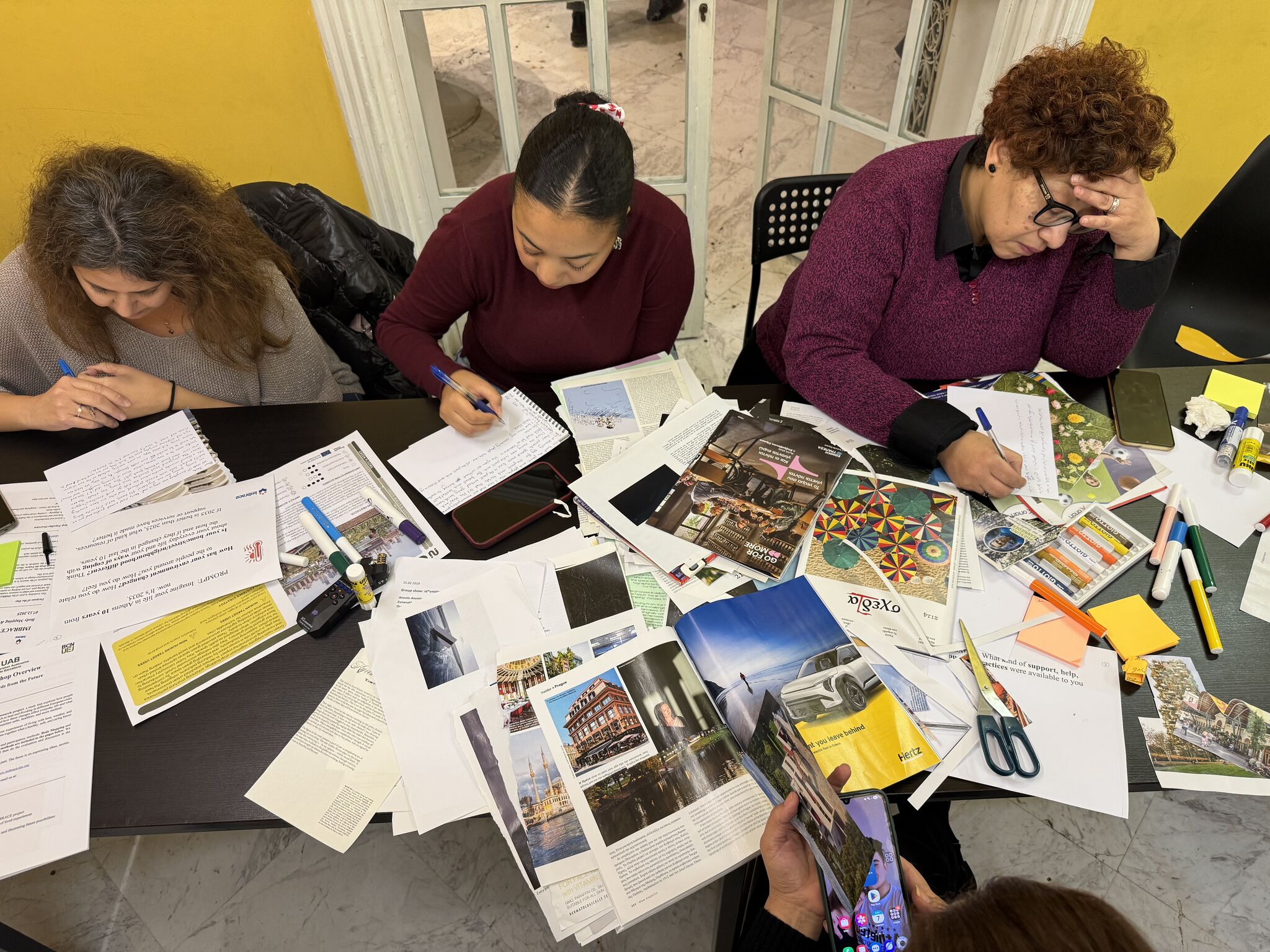
Using Body Mapping, a feminist and embodied method, participants expressed how extreme heat feels on their bodies and emotions through drawing, collage and visual storytelling. This approach created space for reflections that often remain unheard in conventional research or policy discussions.
Heat was described not only as physical discomfort, but also as exhaustion, anxiety, disrupted sleep, reduced mobility and heightened vulnerability, particularly in overcrowded housing or neighbourhoods with limited shade and green space.


Imagining a just Athens
The workshop also looked ahead through Postcards from the Future, a collective imagining exercise. Participants envisioned Athens 10 to 15 years from now as a cooler, greener and more inclusive city rooted in community care and collective resilience.
These visions were not abstract. They were grounded in everyday needs.
As discussions evolved, participants shared personal coping strategies and identified the structural changes needed for fair and effective climate adaptation:
-
Accessible green spaces within walking distance
-
Safe and climate-comfortable housing
-
Reliable and comfortable public transport
-
A stronger sense of safety and belonging in public space
These reflections highlight a core principle of IMBRACE. Climate adaptation is not only about infrastructure. It is also about justice, dignity and everyday wellbeing.
Migrant knowledge as climate knowledge
The Athens workshop marks an important step for the IMBRACE project. By centring migrant women’s lived experiences, we recognise that community knowledge is essential for shaping climate health adaptation strategies that are both equitable and effective.
As heatwaves intensify across Southern Europe, the insights emerging from Athens remind us that adaptation must be shaped together with those most affected.
Photo credits: Fizza Fatima, Urbana