Editor’s note: This article by Sergio Ruiz Cayuela and La Florida s’Aveïna was originally published in Spanish in elperiodico in March 2026.
In a neighborhood often described as a “nightmare,” La Florida’s ecosistema barrio tells a different story: one of dignity, resistance, and collective futures.
“Living in La Florida: A nightmare.” This was the headline of a report broadcast on Spanish television in October 2022. The story focused on insecurity, illegal squatting, and called for stronger policing. Once again, La Florida was portrayed as a problem to be contained rather than as a community shaped by decades of structural neglect.
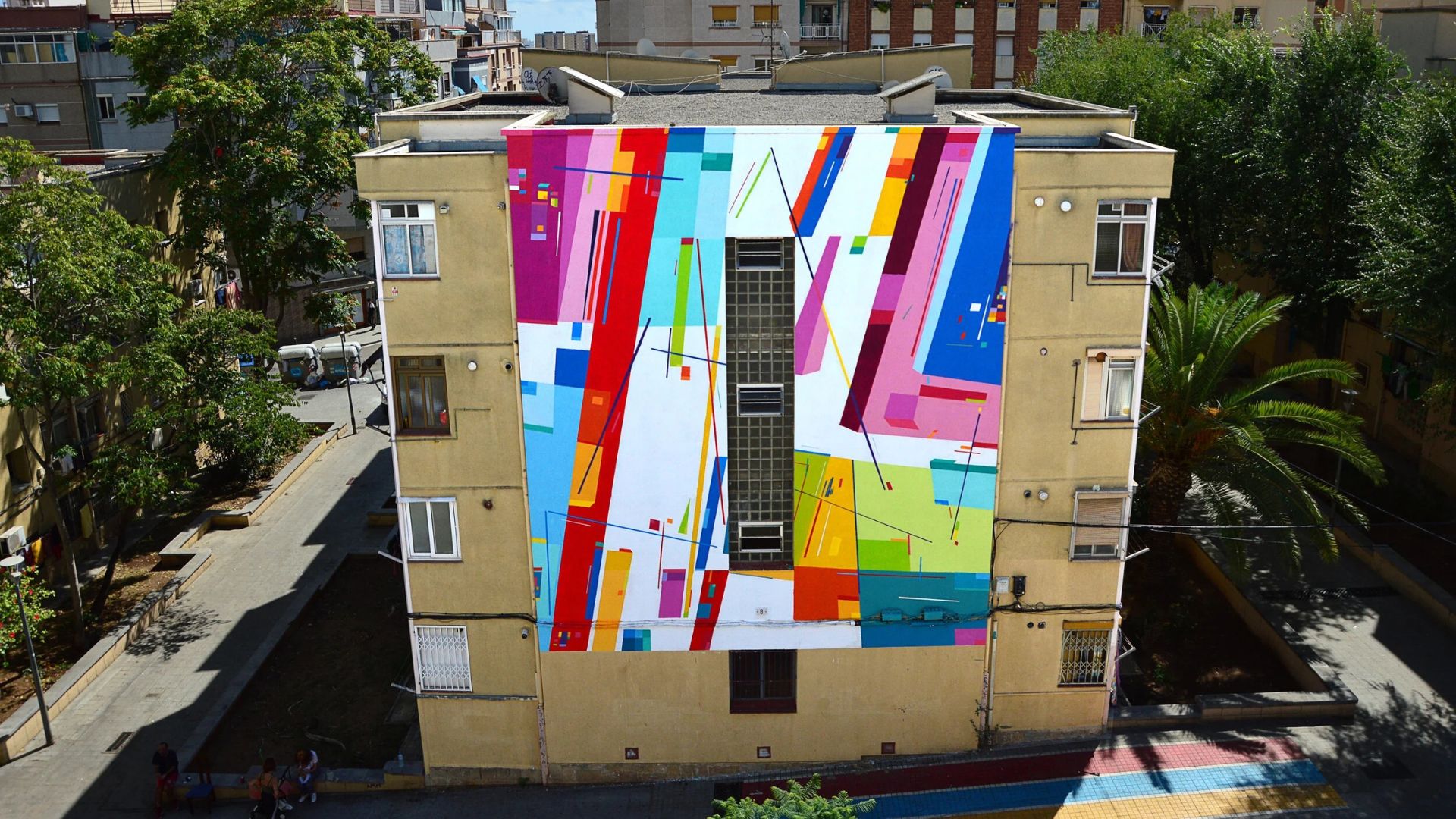
La Florida is a neighborhood (though administratively divided into La Florida and Les Planes) located in L’Hospitalet de Llobregat, within the Barcelona metropolitan area. Built in the early 20th century to house workers who had migrated from rural areas during Catalonia’s industrial boom, it grew rapidly after the Spanish Civil War, particularly with the inauguration in 1954 of the iconic residential complex Bloques Onésimo Redondo, today known as the Blocs Florida.
Today, La Florida is considered the most densely populated neighborhood in Europe, with more than 50,000 people living in just over 0.8 square kilometers. Even this figure is likely an underestimate, as many residents are denied the right to register officially (empadronamiento) and therefore do not appear in official statistics. More than half of the neighborhood’s residents were born abroad, mainly in South and Central America, South Asia, and the Maghreb.
Daily life in La Florida is marked by housing precarity and substandard living conditions, as well as limited access to public services and green spaces. Poverty levels among residents are alarming, and recent research indicates that La Florida is one of the areas most vulnerable to climate impacts in the Barcelona region.

For many residents, the current situation is not the result of chance but of what they describe as a “strategy of abandonment and containment” by public authorities, whom they accuse of being “at the service of a hegemonic neoliberal model of wealth accumulation.” Residents say the area has been systematically neglected and that social unrest has been managed through approaches aimed at “sanitizing” the neighborhood with superficial aesthetic projects rather than addressing the structural causes of inequality. Their experience is often summed up in a phrase repeated by many residents: “We are not poor—we have been impoverished.”
Far from passively accepting this reality, La Florida has a long history of grassroots organizing to defend collective autonomy. Over the past two decades, residents have built what they call an ecosistema barrio—a dense network of initiatives that challenge processes of urban dispossession and aim to achieve cultural, food, and housing sovereignty. This ecosystem includes, among many other initiatives, a consumer cooperative, a housing cooperative, a neighborhood magazine, a cultural collective, several worker cooperatives, a popular school, a textile creation group, and a community kitchen. Mutual aid and the collective organization of care and reproductive work are at the heart of all these initiatives.
While these organizations clearly point to the role of the city council and other institutions in producing the inequality affecting the neighborhood, they have also developed a pragmatic relationship with public administrations. Without compromising their autonomy, several local organizations participate in public funding programs. Initiatives such as Comunalitats Urbanes and Ateneus Cooperatius have helped consolidate the neighborhood ecosystem by providing resources to improve residents’ well-being and foster a shared neighborhood culture that brings together La Florida’s diverse communities.
This network of grassroots infrastructures that forms the ecosistema barrio has positive effects on the climate adaptation capacity of some of the most vulnerable residents by ensuring access to food, generating dignified work, and strengthening community ties. In La Florida, however, vulnerability to heat and climate adaptation are not addressed only indirectly—they are also central to the community’s agenda.

One example is the grassroots response to the removal of the flowerbeds surrounding the Blocs Florida in 2023. As part of a municipal intervention plan to “sanitize” and “regenerate” the area, a municipal work crew arrived one morning without prior notice to dismantle the concrete structures supporting some of the few existing green spaces. Some residents responded immediately—even placing their bodies in front of the heavy machinery—and blocked the demolition.
This spontaneous act of resistance was not only about protecting the flowerbeds. It was about defending one of the few central public spaces in the neighborhood where residents gather, rest, and find shade. The blockade was made possible by a strong sense of collective identity and attachment to place, cultivated over the years and strengthened through the ecosistema barrio.
Another relevant example is the community group La Florida Es Planta, which campaigns for more green spaces in the neighborhood. In response to the demolition of the flowerbeds, one of their actions involved measuring temperatures in different areas, revealing differences of up to 18°C between green areas and asphalted spaces. This and other actions have become tools for raising awareness and highlighting thermal inequality in the neighborhood.
The group also manages an open-access seed bank with species adapted to local conditions and encourages neighbors to create gardens and small vegetable plots on their balconies and in any small patch of available public space.
These experiences confirm the importance of grassroots infrastructures and community networks in confronting the current ecosocial crisis intensified by climate change. This is the case with La Florida’s ecosistema barrio: an interdependent network based on processes of commoning and mutual aid capable of offering collective responses to growing climate vulnerability.
In a neighborhood so often described as a “nightmare,” La Florida’s ecosistema barrio tells a very different story—one of dignity, resistance, and shared futures.
This article was written by Sergio Ruiz Cayuela and La Florida s’Aveïna.