“In Athens, we feel like we are neither the East nor the West, but the middle point where the East meets the West.”
I heard this sentence repeatedly during my fieldwork in Athens, from Greek residents and migrants alike. It captures a shared feeling in the city: a sense of being in–between worlds, belonging fully to neither. As a Pakistani migrant based in Barcelona, I am not unfamiliar with this feeling. Edward Said’s notion of being “between worlds” describes well the experience of navigating multiple identities while constantly negotiating one’s fractured sense of belonging. Entering Athens as a researcher studying how climate change affects migrants in Europe, and as a non-European migrant myself, I was particularly attuned to these contradictions. On one hand, I am still within the European Union. While on the other, the urban layout of Athens, the rhythms of daily life, and the sounds of the city remind me very much of Karachi, where too, cars have the dominant ‘right to the city’ (Lefebvre, 1996).
These questions of belonging are not only cultural. They are also deeply spatial.

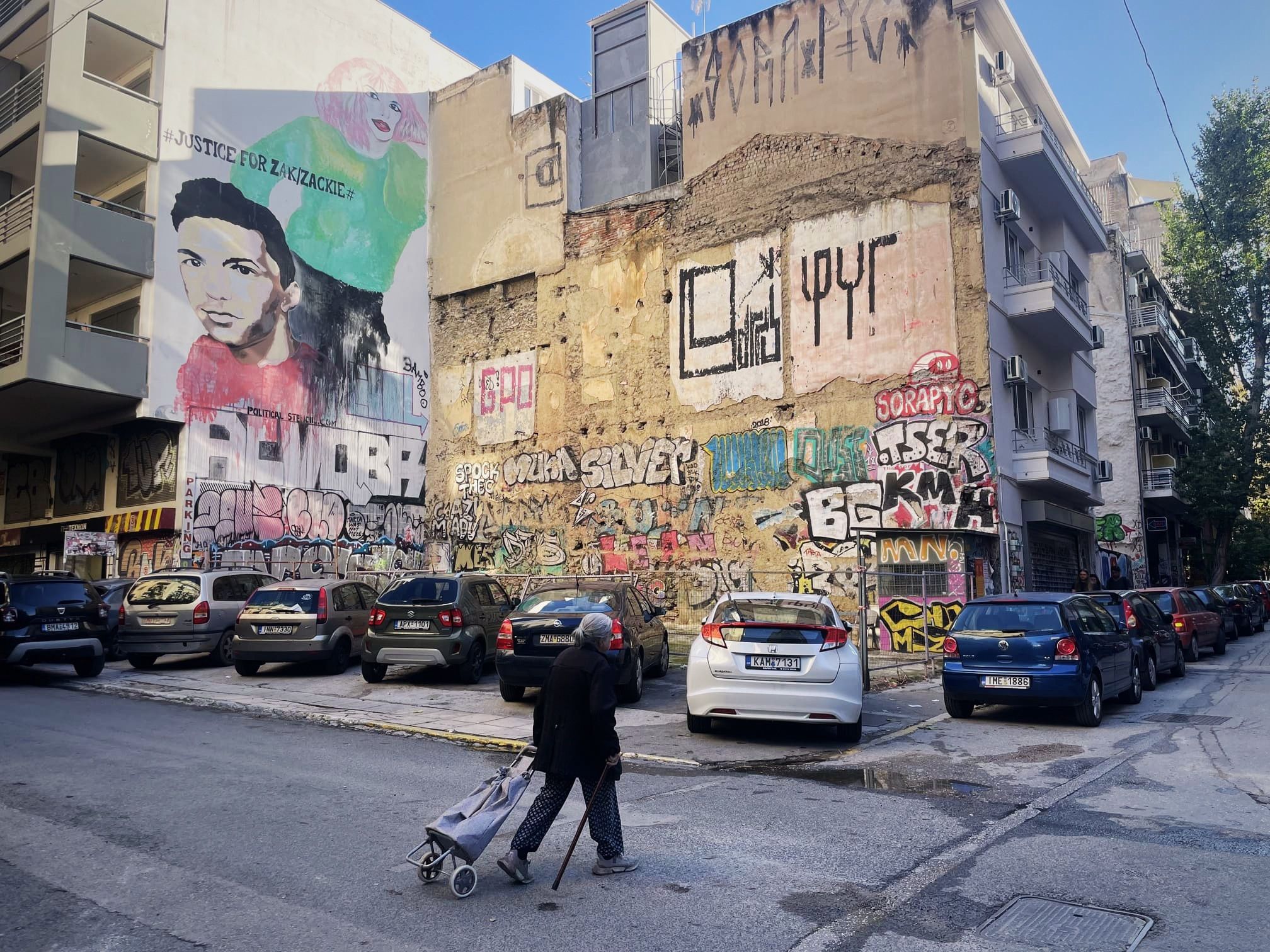
An old woman is seen crossing the street while the sidewalk is obstructed with cars. © Fizza Fatima

A typical polikatoikia facade in the Kipseli neighbourhood. © Fizza Fatima
The old versus the new
Athens is a city with history, where ancient traditions remain intertwined with modern life. Yet it is also grappling with contemporary challenges: gentrification, rising housing costs, and increasingly unlivable—often non-eco-friendly—homes. These dynamics are especially visible in Kipseli and Viktoria, my two case study neighborhoods, where I examine how heatwaves affect the health of migrant communities. Following suburbanization in the 1990s, many middle- and upper-class Greek residents moved to the outskirts of the city. This shift opened up more affordable housing in central neighborhoods, which were subsequently inhabited by migrant communities.
Areas such as Patisia, Kipseli, Metaxourgeio, and Viktoria have since become widely recognized as migrant neighborhoods. Yet their residents are often framed within political discourse as “illegal immigrants,” reinforcing stigmatization and exclusion.
These neighborhoods are defined by the polikatoikies—apartment blocks built through the antiparochi system, a bottom-up “flats-for-land” model in which landowners exchanged plots for apartments in newly constructed buildings. While this system enabled rapid urban development, it also led to high-density construction and a form of vertical social segregation that is unique to Athens. Higher floors typically offer better living conditions—more light, ventilation, and safety—while lower floors tend to be more crowded and exposed to noise and pollution.

Map showing vertical ethnic segregation in the central areas with over-representation of migrants on the lower floors. Athens Social Atlas
Morphology and character of migrant neighborhoods
Daily life in these neighborhoods reveals how urban form shapes lived experience. One striking feature is the lack of green space. Athens offers just 2.55 m² of green space per capita—far below the 15 m² commonly found in other European cities. Walking through central neighborhoods can feel like an obstacle course: sidewalks are often narrow, uneven, or abruptly interrupted. They are frequently blocked by lampposts, trees, signage, parked cars, and even private staircases.
It was only when I visited Chalandri, a higher-income neighborhood, to meet Urbana, one of our local partners that I noticed something missing from the city centre: bike lanes—and bicycles themselves. As an urban planner trained to notice these details, my instinct was to blame Athens’ chaotic streets and move on. Yet the difficulty of navigating the city kept resurfacing in conversations with residents. One participant, a young mother with an infant, described how she often had to lift her child’s stroller because sidewalks either ended suddenly or lacked ramps. For her—and for wheelchair users—moving through the city without assistance is often impossible. These spatial challenges are not just inconveniences; they directly shape how people move, interact, and cope with environmental stressors such as extreme heat.

Footpath obstructed by the entrance steps of a building. © Fizza Fatima

True to the Foucouldian nightmare we live in, my social media learned I was in Athens and the above picture popped up on my Instagram, which claims Athens has been ranked the world’s ‘most walkable city’. Given the account is called ‘Páme Athens’ (páme in Greek means “let go”/ “let’s go”), I laugh at the irony and make myself “páme”. via @PameAthens
Between Hostility and Solidarity
These urban challenges are further compounded by an increasingly hostile policy environment. In 2025, a new law was passed by the Greek government that further criminalizes migration, requiring asylum seekers with rejected applications to leave Greece within fourteen days or risk prison sentences of 2-5 years or heavy fines. The political rhetoric surrounding migration has also hardened. During parliamentary debates, statements such as “You are not welcome” have reinforced a climate of exclusion.
This broader context was echoed in interviews with experts and discussions at the Sociology of Migration Midterm Conference, which coincided with my fieldwork. As one participant noted, “it is simply a bad time for the left and anti-racist movement in Greece.”
And yet, alongside this hostility, a dense network of grassroots organizations offers a lifeline to migrant communities. From the solidarity kitchens of Viktoria Community Centre, Ankaa, and Steki, to community laundry service, and regular protests and solidarity events for Palestine and Sudan, the Athenians offer great lessons on collective solidarity, anti-racist self-organizing and persevering in fascist times.
Another testament to this are the many migrants’ collectives located in Kipseli, Viktoria and Metaxourgeio, many of whom we are collaborating with including Greek Forum of Migrants who seem to be working as a microcosm of migrant collectives and unions with great outreach and trust within the community. They not only housed our workshops but graciously guided us and supported us with community outreach. We are also being supported by Melissa, a network working for and with migrant women and regularly organize events to empower women, and Babel, a day centre providing free mental health services to migrants and refugees. I also met with Global Brigades Greece and learned about their free health services for all migrants regardless of documents including checkups, vaccinations, exams, medicines and counselling. Overall, it has been great to receive the support from these local collectives who are not only connected to migrant communities, but also understand their needs and challenges closely, which has helped me make slight adjustments to our methods to accommodate and respect the needs of the community.


Posters of spaces offering free meals, books and laundry services. © Fizza Fatima
Returning in the Heat
Athens, then, presents a striking paradox. While its political and built environments can be deeply challenging, the strength of solidarity networks makes it a uniquely rich context for understanding how migrants navigate urban life under pressure.
My research explores how heatwaves intersect with housing conditions, urban design, and migration policies to shape the health outcomes of these communities. It also examines how community networks influence migrants’ ability to cope with and adapt to extreme heat—often stepping in where municipal support is limited.
I will return to Athens very soon to conduct further workshops and interviews before wrapping up my field work. Having experienced Athens in the winter rain and spring winds, I will return in the summer—when heatwaves make these vulnerabilities impossible to ignore. It is then that the intersections of housing, migration, and heat will be most visible in everyday life.